

Ask anything
Ask anything
✕
A low daily dose of ketamine you take at home, prescribed by a licensed clinician and adjusted to you from your own check-ins. Here is what treatment looks like, and whether it fits your situation.
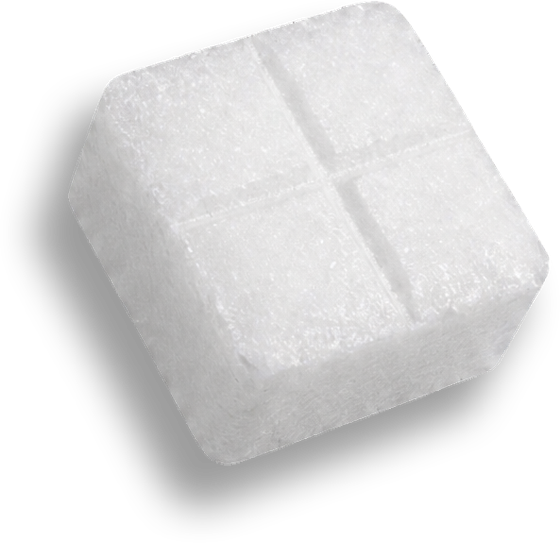
Joyous treats depression, anxiety and PTSD with a provider-directed daily protocol: a licensed clinician approves treatment and sets your starting dose by video, daily check-ins track how you respond, and your dose is adjusted over time, with every change approved by your clinician.
Ketamine is FDA-approved as an anesthetic and prescribed off-label for mental health. It works through glutamate, not serotonin: by boosting glutamate signaling, ketamine can promote neuroplasticity, the brain's ability to form new connections and adapt over time.
Negative thought loops and a body that won't switch off. A low daily dose designed to fit into your day, adjusted by your clinician from your check-ins.
of patients name relief from stress and anxiety as a goal when they start · intake goals, multi-select · n = 28,013
Sudden waves of fear, a nervous system that never stands down. Joyous treats anxiety and PTSD, and the average patient started in the severe range.
Severe to mild range in six weeks. Group average among patients who started at moderate or worse and stayed in treatment · n = 41,510
When nothing feels worth doing. About 1 in 5 Joyous patients also lives with chronic pain; your clinician treats the depression and anxiety that often come with it.
Moderately severe to mild range in six weeks. Group average among patients who started at moderate or worse and stayed in treatment · n = 43,563
Ketamine works through glutamate, not serotonin, so emotional blunting, weight gain and low libido aren't known side effects of it. It has its own, mostly drowsiness and dizziness, and each became less common over the first six weeks.
had already tried three or more antidepressants before Joyous · self-reported · n = 49,186
Never stop or change a medication without talking to your prescriber.
Clinicians may also prescribe for other conditions they diagnose and deem appropriate. Read about OCD, grief, chronic stress and sleep.
Many patients notice a change in the first week or two — but benefits compound.
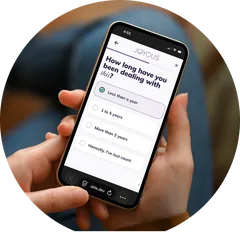
Your dose is found, not guessed. Start low. Check in daily. Your clinician adjusts until it's right.

A buccal troche: a small, alcohol-free tablet that dissolves against the inside of your cheek, so it absorbs through the mouth rather than the stomach. It's a low daily dose, prescribed off-label by a licensed clinician and tailored to you.
Treatment starts low and rises in small steps only as tolerated, until your clinician finds your lowest effective dose. There is no standard dose: yours is set from your own daily check-ins, and every dose change is approved by a licensed clinician. Your clinician is available on demand at any point in treatment.
More on ketamine troches and low dose ketamine →
Subtle by design, not a trip.
It is less about an altered state and more like clearing the fog off your windshield. You remain completely in the driver's seat, taking your dose and getting on with your day.
Relaxed.
Subtle.
Open.
Share of patients who have ever selected each feeling in their daily check-ins during treatment · n = 30,355
You stay coherent and aware throughout. Side effects at this dose are mostly mild and fade quickly—about 1 in 4 patients report feeling a bit lightheaded or floaty. Because the protocol is explicitly designed not to produce a high, the risk of developing a ketamine problem during treatment is judged to be low.
✓ Are an adult living with depression, anxiety or PTSD
✓ Want treatment you can take at home, in your daily routine
✓ Are open to a video visit with a licensed clinician
✕ Have psychosis or bipolar I disorder
✕ Have active suicidal intent
✕ Have uncontrolled high blood pressure
✕ Have a history of seizures, stroke or brain injury
✕ Are pregnant or breastfeeding
✕ Have an active or past substance use disorder
✕ Already have a ketamine or esketamine prescription
Your clinician makes the final decision. Please don't change any current medication without talking to your prescriber.
“It’s the fact that I can function on such a small amount of medication instead of having to take 5–6 different things at once to manage my mental health. […] Now I take my Joyous, and it keeps me stable, productive, and full of joy! People notice the difference at work, at home, and at church. The impact it’s had on me is genuinely noticeable, and in such a positive way.”
★★★★★ Snookes · Trustpilot, Sep 2026
“Before joyous, my panic attacks controlled me. Multiple times a day […] Now, I’m able to pull myself out of the panic attacks a lot quicker. I recommend this to EVERYONE struggling with depression and anxiety.”
★★★★★ Lynn H. · Trustpilot, Nov 2025
“About 9 months ago, I decided that I’d lived with it for too long. […] After 8+ months on the ketamine treatment, I am feeling markedly better. I feel that I’ve gotten my life back to a great degree. I am hopeful.”
★★★★★ Aundrea M. · Trustpilot, Oct 2025
“I had used SSRIs in the past which fell flat and made me feel worse. Ketamine therapy helped me actually get to the root of problems, recall painful experiences with grace, and manage moderate-severe depression.”
★★★★★ Jenni D. · Trustpilot, Apr 2025
Public reviews from Trustpilot, shortened where marked […]. Individual results vary.
Our low-dose protocol is designed to keep you fully present and coherent during treatment. After about 15 minutes you may notice a subtle calm and possibly some lightheadedness that quickly dissipates. While we recommend taking a moment for meditation or reflection, many patients proceed with their daily routines. Some patients feel a little "out of it" for 30 to 40 minutes. If such effects occur, the dose can be split in two. Over the first weeks your dose is adjusted from your daily check-ins, so if the feeling isn't right it will get adjusted.
Antidepressants are generally described as taking four to eight weeks to work. In the Joyous cohort the average depression score had dropped 38% by the end of week one, and the typical patient's score was cut in half within about 16 days. That is a median among people who responded and stayed in treatment; half took longer, and reaching the remission range took a median of 48 days — but results compound.
At Joyous, ketamine treatment is a small daily dose, not a series of sessions. Your clinician starts you low and finds your lowest effective dose over the first weeks; most of the change in depression scores showed up in the first six weeks. After that you move to maintenance: stay on your dose, keep checking in, adjust as needed with your clinician. At this dose ketamine is not addictive, and there is no set number of treatments to complete.
Many patients continue their existing antidepressant during treatment. Your clinician reviews your current medications at your video assessment and decides what is compatible. Bring your medication list. Never stop or change a medication without talking to your prescriber.
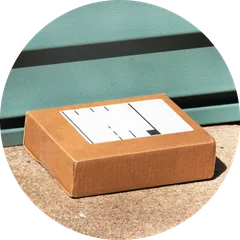
It depends on your state. Shipping frequency is set so you always have medication for the month; it is separate from monthly billing.
On the $159 month-to-month plan, you can cancel by completing the off-boarding form (in your Automated Actions link) or by texting (844) 774-0909. On the $129 plan, the remaining months of the three-month commitment are still due if you cancel early; after that it is month to month. On either plan, your subscription stays active until the end of the billing period. If medication was dispensed within 14 days of your next billing date, that payment is still processed.
“Mental healthcare shouldn’t require you to put your life on pause. We built a daily, provider-directed protocol that is highly efficacious and fits into real routines — meeting you where you are, at home.”
Bobbi Leben, MD · Co-founder and Chief Medical Officer, Joyous
If you're in emotional distress or crisis, the 988 Suicide & Crisis Lifeline connects you with a counselor immediately.
If you're having a medical or mental health emergency, call 911 or go to your local ER.
Ketamine is FDA-approved as an anesthetic and prescribed off-label for depression, anxiety and PTSD. Side effects can occur; your clinician will review risks with you. Joyous is not for emergencies.


